


Welcome to the fourth issue of the Knightian Uncertainty Dispatch — a monthly curated reading list for anyone thinking about macroeconomics, finance, and forecasting in a world where the future is not just risky, but sometimes genuinely unforeseeable because it may differ from the past.
Each month, I recommend four new papers + one “essential” that help grapple with structural change and uncertainty beyond probabilistic risk — and what those realities imply for economic modeling, forecasting, and policymaking.
The goal is to curate papers that:
Deepen our understanding of structural change and Knightian uncertainty.
Are useful for how we actually reason and forecast in unstable environments.
Connect to one another — so the pieces speak to each other rather than living in isolated silos.
This month’s theme is the revolution in central bank forecasting: from fan charts to scenarios.
On 28 February 2026, the United States and Israel launched air strikes against Iran. The war that followed has disrupted shipping through the Strait of Hormuz — through which roughly 20 percent of the world’s oil supply normally passes — and attacks on energy infrastructure, including the Ras Laffan facility in Qatar, have raised the prospect of lasting damage to global oil and gas supply. Oil prices have surged to levels comparable to 2022. The International Energy Agency has called it the largest supply disruption in the history of the global oil market.
This is not just a large shock. It is a potential structural change in global energy supply — and the uncertainty it creates is not the familiar kind that can be captured by widening a confidence interval around a baseline forecast. Nobody knows how long the conflict will last, whether the infrastructure damage is reversible, how energy markets will reorganize, or how the shock will propagate through an economy that still carries the memory of the 2021–23 inflation surge. The uncertainty is about which world we are entering, not just how far we might deviate from the expected path. In other words, we face substantial Knightian uncertainty, not just probabilistic risk.
Central banks recognized this immediately. At the March 18 meeting of the Riksbank’s Executive Board, Deputy Governor Per Jansson made a remarkable admission: “I actually find it difficult to identify a clear main scenario among all the possible development paths ahead.” A sitting central banker, publicly stating that the concept of a baseline forecast — the single most likely path — is itself problematic.
Jansson was not alone. In the same week, the ECB dropped its fan charts entirely, replacing them with alternative scenarios. The Riksbank framed its decision around three scenarios, stressing that its revised baseline was “highly uncertain this time” and that all three scenarios were needed to understand the policy choice. The Bank of England’s Chief Economist gave a speech on robustness — arguing that optimization within a single model is the wrong approach under “radical uncertainty.” And ECB President Lagarde opened a speech with the words: “We find ourselves yet again in a different world, whose contours are not yet clear.”
I wrote three posts in March tracing this shift as it unfolded:
What Should a Forecast Look Like When the World Might Be Changing? (March 17), written as the oil price surge was reshaping the outlook, argued that when the economy might be undergoing structural change, a single forecast with a fan chart is the wrong format — and proposed a scenario-based alternative with narratives, conditional forecasts, within-scenario bands, and signposts.
Risk vs. Knightian Uncertainty: Why the Distinction Matters (March 20), published the day after seven central banks announced their decisions, explained the theoretical foundation: the distinction between risk and Knightian uncertainty rests on the economy undergoing nonrepetitive structural change — exactly the kind of change a war-driven restructuring of global energy supply represents.
The Quiet Revolution in Central Bank Forecasting (March 27) documented how those seven central banks responded to the same oil price surge with strikingly different uncertainty communication approaches — and argued that scenarios are replacing fan charts because they better match the structure of the uncertainty central banks actually face.
This Dispatch provides the primary source reading behind those three posts — the voices of the revolution itself, and the institutional survey that documents it is happening globally.
A note on format. This issue features three speeches and one institutional survey rather than the usual academic research papers. That is deliberate. While academic work on uncertainty, robustness, and scenario design has been developing for some time, the most visible action right now is inside institutions — in speeches, monetary policy reports, and strategy reviews. The speeches below are primary documents of a paradigm shift unfolding in real time. The formal theoretical foundation — connecting structural change, Knightian uncertainty, and scenario-based forecasting — is still catching up with institutional practice. That is both encouraging and, for those of us working on the theory, a source of urgency.
Paper #1: The ECB President on “A Different World”
Speech: “Navigating Energy Shocks: Risks and Policy Responses” by Christine Lagarde, President of the European Central Bank. Delivered at The ECB and Its Watchers Conference, Goethe University Frankfurt, 25 March 2026. Link
This speech was delivered six days after the ECB’s March 19 monetary policy decision — the meeting where the ECB dropped its fan charts from the staff projections, replacing them with three alternative scenarios. In the projections document, the staff stated explicitly that “the standard computation of the fan charts (based on historical projection errors) would not, in the present circumstances, provide a reliable indication of the high uncertainty surrounding the current projections.” Lagarde’s Watchers speech is the strategic rationale for that decision.
The opening is striking: “But we find ourselves yet again in a different world, whose contours are not yet clear. We are facing profound uncertainty about the path of the economy.” This is not hedging — it is the ECB President stating that the uncertainty the ECB faces is about the shape of the future itself, not just the parameters within a known model. The contours of the new regime are not yet observable.
Lagarde then sets out three principles from the ECB’s updated 2025 strategy. First, assess the nature, size, and persistence of the shock before acting. Second, focus on risks alongside the baseline — “because the effects of significant price shocks on inflation can be non-linear, we need to work with scenarios.” Third, respond in a graduated way depending on the shock’s intensity: look through small temporary shocks; make measured adjustments for large but not-too-persistent overshoots; act forcefully against significant and persistent deviations.
The speech draws an extended comparison between the current energy shock and 2022. Lagarde argues the macroeconomic backdrop is more benign today — lower starting inflation, no demand-supply imbalances, neutral policy stance, neutral fiscal stance. But she flags an important asymmetry: “An entire generation has now lived through its first episode of high inflation — and it may not be as slow to react a second time.” This is a regime-dependent behavioral parameters argument: the same shock may produce different outcomes because the lived experience of 2022 has changed how firms and workers respond.
A comment. The most analytically significant passage is one that could easily be overlooked: “We judged that we were moving into a world of more frequent supply shocks — we have faced at least four major ones since 2020 — and structurally higher uncertainty.” This is not a claim about this particular shock. It is a structural change claim about uncertainty itself — the ECB updated its strategy because it concluded the regime of uncertainty has permanently shifted. During the Great Moderation, the economy appeared stable enough that the future looked like the past — probabilistic risk, quantifiable from historical data, was a reasonable approximation. That world is gone. What has replaced it is an environment where energy markets, trade networks, wage-price dynamics, and geopolitical alignments are all changing in ways that cannot be forecast from past patterns. That is the shift from probabilistic risk to Knightian uncertainty — and Lagarde is describing it in institutional language, even if she does not use the term.
In one quote
“But we find ourselves yet again in a different world, whose contours are not yet clear. We are facing profound uncertainty about the path of the economy.”
Why I’m recommending it
This is the ECB President articulating Knightian uncertainty in plain language — not as a theoretical abstraction, but as the operational reality facing the world’s second-largest central bank.
The speech explicitly connects the ECB’s 2025 strategy update to “structurally higher uncertainty” — a structural change claim about the nature of uncertainty itself, not just its magnitude.
The regime-dependent pass-through argument — that the 2022 experience may have changed behavioral response functions — is precisely the kind of insight that constant-parameter models cannot capture.
Delivered six days after the ECB dropped fan charts, this is the primary document explaining why the most significant change in central bank uncertainty communication in a decade happened.
The takeaway
The ECB President is describing the world the way the research program on Knightian uncertainty argues it should be described: the future may differ from the past, probabilistic tools calibrated on history fail when that happens, and multiple scenarios — not a single baseline forecast with a fan chart — are the appropriate response.
If you only read a few pages
Read the opening paragraphs through “three principles,” then the section on “Managing Uncertainty” where Lagarde explains the role of scenarios and the 2025 strategy update.
Paper #2: The BoE Chief Economist on Why Robustness Beats Optimization
Speech: “Robustness” by Huw Pill, Chief Economist and Executive Director of Monetary Analysis, Bank of England. Delivered at the National Bank of the Republic of North Macedonia and SUERF conference, Skopje, 24 March 2026. Link
If Lagarde provides the strategic vision for why central banks are shifting to scenarios, Pill provides the analytical framework. His speech is the most theoretically rigorous of the central bank pieces in this Dispatch — and also the most direct in naming the intellectual challenge.
Pill opens by describing the standard view of monetary policy as “engineering” — the inflation forecast targeting regime that “marked the apogee of viewing monetary policy as engineering.” He then argues that “experience over recent years has further challenged the belief that the economy and the transmission of monetary policy were simple enough and/or understood well enough to be characterised by a naïve linear modelling framework.”
The speech draws explicitly on Kay and King’s concept of “radical uncertainty” — a term that encompasses “the Knightian uncertainty familiar from economics texts; the Keynesian uncertainty that arises from the strategic interaction among economic actors; and, more simply, the ‘unknown unknowns’ that plague the policy making environment in practice.” This is a Chief Economist of the Bank of England naming three distinct forms of deep uncertainty and arguing that all three are operationally relevant.
Pill then develops a simple but powerful framework using efficient-locus diagrams to compare Bayesian (weighted-probability) and min-max (worst-case) approaches to policy selection across competing scenarios. The key result comes from the non-convex case: when the efficient locus is not convex, small changes in beliefs can produce discontinuous jumps in preferred policy. This makes scenario diversity analytically necessary — not just good practice — because the policy landscape itself has discontinuities that a single model cannot reveal.
Pill connects this directly to the Bernanke Review, noting that for many stakeholders, Bernanke’s guidance can be distilled to one word: “scenarios.” But he goes further than Bernanke in explaining why scenarios are necessary from a robust control perspective.
In the applied section, Pill argues that structural change in price and wage dynamics — not just shock magnitude — is what makes the current environment difficult. He distinguishes two interpretations of why inflation was more persistent than expected after 2022: a cyclical tightness interpretation (which would be reassuring for the current shock) and a structural change interpretation (which would not). His own assessment: “the burden of proof lies on the side of those seeking to deny a role for structural change.”
A comment. The speech’s most remarkable passage appears in footnote 30: Pill worries that relying on “small perturbations of the baseline scenario in a workhorse New Keynesian model estimated on data largely from the Great Moderation period” would leave him “vulnerable to missing more appropriate policy prescriptions that would derive from a fundamental rethink of the relevant macroeconomic dynamics.” This is a Chief Economist of the Bank of England admitting — in a formal speech — that the standard model may be fundamentally wrong, that he knows it, and that he adjusts his policy deliberations accordingly. It is difficult to find a more candid institutional acknowledgment that constant-parameter models are inadequate under structural change.
In one quote
“Given these concerns, I internalise in my policy deliberations the possibility that small perturbations of the baseline scenario (e.g. slightly increasing the slope of the wage PC in a workhorse New Keynesian model estimated on data largely from the ‘Great Moderation’ period) would leave me vulnerable to missing more appropriate policy prescriptions that would derive from a fundamental rethink of the relevant macroeconomic dynamics (e.g. models of price- and wage-setting behaviour harking back to the 1970s and ‘80s, where real income resistance plays a greater role).” — Footnote 30
Why I’m recommending it
Pill provides the analytical theory that Lagarde and Seim implicitly rely on. The efficient-locus framework shows why non-convexity makes scenario diversity analytically necessary — not just good practice.
The explicit naming of Knightian uncertainty, Keynesian uncertainty, and unknown unknowns as distinct and operationally relevant is rare from a sitting central bank Chief Economist.
Footnote 30 may be the most candid admission in the entire central bank archive that the standard New Keynesian model is inadequate for policymaking under structural change.
The distinction between cyclical tightness and structural change interpretations of inflation persistence frames the current policy dilemma with unusual clarity — and Pill openly states which side he’s on.
The takeaway
Pill provides the formal case for why robustness — not optimization — is the right approach when facing radical uncertainty. The efficient-locus framework is simple enough for practitioners but powerful enough to show why scenarios are analytically necessary. And footnote 30 is worth reading closely: it is rare to see a sitting policymaker acknowledge this openly that “a fundamental rethink of the relevant macroeconomic dynamics” may be needed.
If you only read a few pages
Read pages 4–5 for the radical uncertainty discussion and the link to the Bernanke Review, then Charts 1–3 (pages 8–11) for the efficient-locus framework, then pages 13–14 for the structural change discussion, and finally footnote 30 (page 18).
Paper #3: The Riksbank Deputy Governor on How Scenarios Actually Work
Speech: “The Role of Alternative Scenarios in Monetary Policy Communication” by Anna Seim, Deputy Governor of Sveriges Riksbank. Delivered at the 2025 ECB Forum on Central Banking, Sintra, Portugal, 2 July 2025. Link
The Riksbank has been publishing alternative scenarios alongside its policy rate path since 2007 — longer than any other central bank. If Lagarde provides the strategic vision and Pill provides the analytical framework, Seim provides something equally important: the operational implementation. This speech is the most detailed insider account of how scenario-based monetary policy communication actually works in practice.
Seim draws the contrast sharply. Fan charts “visualize uncertainty based on historical forecast errors” — they assume the future will look like the past. Scenarios, by contrast, are “coherent macroeconomic narratives about specific developments” that illustrate how the economy and policy would evolve under different structural stories.
The distinction between the two is not just presentational — it is conceptual. Fan charts communicate uncertainty about magnitude within a given model. Scenarios communicate uncertainty about which model — which structural story — applies. When the economy may be undergoing structural change, the second kind of uncertainty dominates, and fan charts are the wrong tool.
The speech’s most compelling exhibit is the December 2024 tariff scenario. In that round, the Riksbank had published a scenario exploring what would happen if U.S. tariffs pushed up Swedish import prices. When the inflation data came in, the outcome matched the scenario’s prediction — but for entirely different reasons. The actual inflation came from temporary food-price shocks, not tariff pass-through. The same inflation outcome, arising from a fundamentally different structural story, required the opposite policy response. The tariff scenario called for tighter policy; the food-price reality did not.
This example is devastating for the fan chart paradigm. A fan chart that showed wider bands around the central forecast would have captured the magnitude of the deviation. But it would have told the policymaker nothing about why the deviation occurred — and therefore nothing about whether to tighten or ease. The scenario, by contrast, provided the narrative structure that made the deviation interpretable.
A comment. What makes Seim’s speech particularly valuable is that she also discusses the challenges of scenario design — questions that most advocates of scenarios gloss over. How many scenarios? How extreme should they be? How detailed? Should they be anchored in specific risks or explore broader structural possibilities? And how should past scenarios be revisited to build credibility? These are practical questions that any institution transitioning from fan charts to scenarios will face, and Seim’s answers are grounded in the Riksbank’s nearly two decades of experience.
In one quote
“In times of radical uncertainty, patterns can change.”
Why I’m recommending it
The most detailed first-person practitioner account of how scenario-based communication works in practice — from the institution that has been doing it longest.
The December 2024 tariff example is a definitive illustration of why narrative matters: same inflation outcome, different structural drivers, opposite policy response. This is the example to use when explaining why fan charts are insufficient.
Seim explicitly uses the phrase “radical uncertainty” and acknowledges that standard econometric models face limitations — an unusually candid admission from a sitting Deputy Governor.
The discussion of practical challenges — scenario design, calibration, ex-post evaluation — provides operational guidance that the other speeches lack.
The takeaway
Scenarios are not just communication devices — they are analytical tools for regime identification. The December 2024 example shows that distinguishing between structurally different worlds is essential for policy, and that fan charts — which communicate magnitude without narrative — cannot do this.
If you only read a few pages
Read the December 2024 tariff scenario example for the most concrete illustration of why scenarios matter, then the section comparing scenarios and fan charts for the conceptual distinction, and the section on challenges when working with scenarios for practical guidance.
Paper #4: The Global Evidence — 25 Central Banks Shifting
Paper: “Evolving approaches to monetary policy communication in the face of uncertainty: fan charts, scenarios and guidance” by Sarah Bell, Matthieu Chavaz, Boris Hofmann, Daniel Rees, and Matthias Rottner. BIS Quarterly Review, March 2026. Link
The three speeches above describe the shift from a single baseline forecast with fan charts to multiple scenarios at three institutions — the ECB, the Bank of England, and the Riksbank. But is this shift systematic or anecdotal? Bell et al. provide the answer: it is global, it is accelerating, and it is documented across 25 central banks from 2006 to 2025.
The paper proposes a useful taxonomy. General uncertainty — the inherent unpredictability of the future — has traditionally been communicated through fan charts, which provide a graphical representation of confidence intervals estimated from past forecast errors. Specific uncertainty — stemming from identifiable risks or developments — is better communicated through alternative scenarios that describe how the economy and policy would evolve under different conditions. The shift the paper documents is from the first to the second.
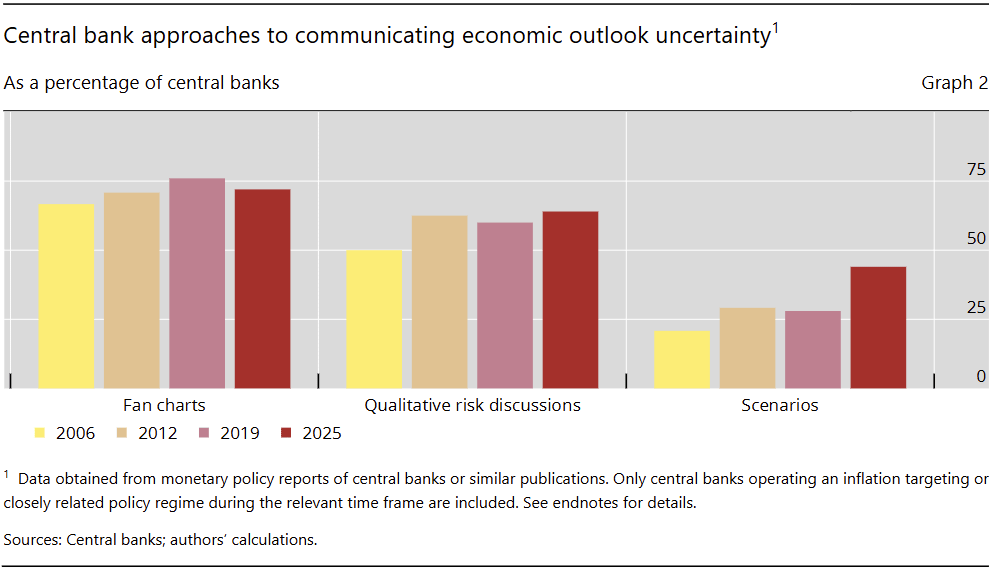
The numbers are clear. Scenario analysis has roughly tripled across the 25 surveyed central banks since 2006 — from approximately 15% to 45% of central banks using scenarios to communicate economic outlook uncertainty. Fan chart usage has declined modestly. Qualitative risk discussions have become near-universal. And increasingly, central banks are embedding policy rate projections within their scenarios — providing scenario-contingent forward guidance rather than unconditional rate paths.
The paper also documents the practical failure that accelerated the shift. The post-Covid inflation surge “revealed the drawbacks of descriptive guidance” — fixed forward guidance was widely interpreted as unconditional commitment, tying central banks’ hands precisely when flexibility was most needed. The shift to scenarios is, in part, an institutional response to this failure.
A comment. The paper’s taxonomy of general vs. specific uncertainty maps, imperfectly but usefully, onto the distinction between probabilistic risk and Knightian uncertainty. Fan charts address general uncertainty by quantifying the range of outcomes within a given model. Scenarios address specific uncertainty by exploring how different structural stories lead to different outcomes and different policy responses. The paper cites Knight (1921) explicitly — acknowledging the distinction between “measurable uncertainty (risk) and unmeasurable (true) uncertainty.” The shift it documents is, in effect, central banks moving from tools designed for measurable uncertainty to tools designed for the unmeasurable kind.
The shift from fan charts to scenarios in one figure
Chart 2 shows the evolution of three approaches to communicating economic outlook uncertainty across 25 central banks from 2006 to 2025. Fan chart usage has declined modestly from about 70% to 65%. Qualitative risk discussions have risen from about 50% to 60%. But the striking trend is scenario analysis: it has roughly tripled, from approximately 15% to 45% of central banks. The institutional shift Lagarde, Pill, and Seim describe at their own institutions is not anecdotal — it is a global phenomenon.
Why I’m recommending it
It provides the cross-bank evidence that the shift described by Lagarde, Pill, and Seim is not three institutions making independent choices — it is a systemic response across 25 central banks.
The general vs. specific uncertainty taxonomy gives the Dispatch audience a practical vocabulary for the distinction between probabilistic risk (fan charts) and structural uncertainty (scenarios).
The paper cites Knight (1921) and explicitly distinguishes measurable risk from unmeasurable uncertainty — connecting the institutional shift to the intellectual tradition this Dispatch is built around.
It documents the failure of fixed forward guidance during the post-COVID inflation surge — an institutional lesson that motivated the shift toward scenarios as a communication tool.
The takeaway
The shift from fan charts to scenarios is not three central banks making independent choices. It is a systemic institutional response to the failure of probabilistic uncertainty tools during structural change. When nearly half the world’s central banks use scenario analysis — triple the share from two decades ago — that is a revolution, not a trend.
If you only read a few pages
Read the taxonomy section on general vs. specific uncertainty, look at Chart 2 for the trend data, and then read the section on scenario analysis for how central banks are using scenarios in practice.
The Essential: The Bernanke Reviews — The Catalyst for the Revolution
Report: “Forecasting for monetary policy making and communication at the Bank of England: a review” by Ben S. Bernanke. Bank of England, Independent Review, April 2024. Link
and
Paper: “Improving Fed communications: A proposal” by Ben S. Bernanke. Hutchins Center Working Paper #102, The Brookings Institution, 2025. Link
Every revolution has a catalyst. For the shift from fan charts to scenarios in central bank forecasting, it is Ben Bernanke’s 2024 review of the Bank of England’s forecasting framework.
The review was commissioned after the BoE’s forecasting failures during the post-Covid inflation surge. But Bernanke’s diagnosis went far beyond “the models were wrong.” He identified a systemic problem with how the BoE — and, by implication, other central banks — communicate uncertainty.
The most consequential recommendation is also the bluntest. Recommendation 11: eliminate fan charts. Bernanke writes:
“Despite their distinguished history, the fan charts as published in the MPR have weak conceptual foundations, convey little useful information over and above what could be communicated in other, more direct ways, and receive little attention from the public. They should be eliminated.”
Fan charts, Bernanke argues, create an illusion of precision about unknowable futures while obscuring the true driver of policy: the central bank’s reaction function — how it would respond if the economy evolved differently from the baseline. The alternative is scenarios. Recommendation 8: publish alternative scenarios alongside the central forecast. Scenarios allow the public to understand the rationale for the policy choice, including risk management considerations, and to see how policy would adapt to different economic conditions.
A year later, Bernanke applied the same diagnostic to the Federal Reserve. The 2025 Brookings paper argues that the Fed’s Summary of Economic Projections and dot plot suffer from analogous problems. The individual projections “provide at best limited insight into why the implied outlook takes the shape it does” and, more importantly, they focus attention on “what each participant sees as the most likely future path for the economy and policy, unhelpfully downplaying the large role of forecast uncertainty in policymaking.”
Bernanke’s proposed remedy is the same: a transparent baseline forecast complemented by alternative scenarios, enabling “quantitative analyses of uncertainty and risks to the outlook” and refocusing communication on the reaction function. He puts it with characteristic directness: “Policy strategies may often be best communicated in terms of policymakers’ reaction function — if this happens, we will do this; if that happens, we will do that — rather than in terms of modal expectations for the economy and policy.”
In one quote
“Despite their distinguished history, the fan charts as published in the MPR have weak conceptual foundations, convey little useful information over and above what could be communicated in other, more direct ways, and receive little attention from the public. They should be eliminated.”
Why these two papers together
One mind applied the same diagnostic to two continents. The 2024 review identified the problem at the Bank of England — fan charts with “weak conceptual foundations,” a forecasting process focused on the single most likely path, and insufficient attention to the reaction function. The 2025 proposal showed the problem is equally present at the Federal Reserve, where the dot plot focuses attention on modal expectations while “unhelpfully downplaying” the role of uncertainty.
Every institutional reform documented in this Dispatch traces back to these reviews. The ECB dropped fan charts (Lagarde). The BoE’s Chief Economist built an analytical framework for robustness (Pill — who explicitly credits the Bernanke Review). The Riksbank refined its scenario practice (Seim). And the BIS documented the global shift across 25 central banks (Bell et al.). Bernanke did not create the movement — the failures of 2021–23 did that — but he crystallized the diagnosis and pointed the way forward.
Reading the two reviews together reveals something important: the same logic applies regardless of institutional specifics. Whether the problem manifests as fan charts (BoE), dot plots (Fed), or staff projections without scenarios (ECB before 2022), the underlying issue is identical. Central banks that communicate primarily through a single baseline forecast, supplemented by probabilistic uncertainty bands, are using tools designed for a world of quantifiable risk. When the economy undergoes structural change — when the relevant uncertainty is about which world we inhabit, not just how far from the baseline we might end up — those tools fail. Scenarios are the institutional response to that failure.
If you only read a few pages
For the 2024 BoE review: read the Executive Summary and Recommendations 7, 8, and 11 for the diagnosis and the key proposals. For the 2025 Fed paper: read pages 12–16 on the reaction function and the proposal for an Economic Review with alternative scenarios.
Closing Remarks
That’s it for the March issue of the Knightian Uncertainty Dispatch.
From Bernanke’s diagnosis in 2024 to Lagarde’s vision, Pill’s analytical framework, Seim’s operational implementation, and Bell’s global documentation — all in under two years. What emerges from reading these five pieces together is not a gradual evolution but a revolution: a fundamental rethinking of how central banks communicate the uncertainty surrounding their forecasts and policy decisions.
The common thread is the recognition that fan charts — probabilistic uncertainty bands calibrated on historical forecast errors — are the wrong tool when the economy may be undergoing structural change. They quantify a kind of uncertainty (how far from the baseline?) while remaining silent about the kind that matters most for policy (which world are we in?). Scenarios address that deeper question by providing narrative-driven explorations of structurally different futures, each with its own policy implications.
What is still missing is the formal theoretical foundation. The institutions are ahead of the theory — they are already doing what the research program on Knightian uncertainty argues for, but without the formal apparatus to explain why scenarios are the right response to structural change. Central bankers like Pill cite Kay and King on “radical uncertainty,” and Lagarde speaks of “a different world, whose contours are not yet clear.” But the connection between structural change, the failure of probabilistic tools, and the superiority of scenario-based communication has not yet been formalized. That is where my research agenda lies.
If you have suggestions for papers I should cover in future issues — especially work that connects structural change, Knightian uncertainty, and real-world forecasting and policymaking — please send them my way.
And if you found this Dispatch useful and want the next issue in your inbox, consider subscribing. It helps the Dispatch reach the people who are interested in developing economic theory and practical forecasting tools for a changing world characterized by Knightian uncertainty.