

Fixed Models in a Changing World
How abstracting from structural change shapes economic theory, empirical "facts," and "puzzles"

Economists often say that “all models are abstractions.” I agree. The question, however, is not whether we abstract, but what we choose to abstract from.
When building economic models, it is usually not problematic to ignore details that are genuinely second-order for the question we seek to explain and understand. For specific questions, it can be perfectly fine to model aggregate outcomes in terms of a representative agent or to linearize a Phillips curve around a given unemployment rate.
But when we ignore structural change—when we build economic models that assume the economy’s structure is constant, or that it only switches between repetitive regimes in foreseeable ways—it’s a very different kind of abstraction. It is not a harmless simplification. It is a substantive empirical claim about the world.
And it is a claim that is often false.
Most economists I talk to agree that labor markets, financial structures, technology, central banks, and political institutions change in ways we do not and cannot fully foresee. We can discuss how often such changes occur—which is ultimately an empirical question—but we seem to agree that they do occur. Yet, most of our macroeconomic and finance models formalize the opposite: a fixed structure in which “shocks” cause economic variables to fluctuate around a single steady state. Nothing that could not have been probabilistically foreseen is assumed to ever happen.
In this post, I will argue that this choice matters. It is not just a harmless simplification. It shapes how we interpret data, what we call a “puzzle,” and where entire literatures go looking for explanations. By abstracting from unforeseeable structural change, we risk misunderstanding the very phenomena we claim to be explaining.
I first explain how the constant-structure assumption enters both theory and empirics, then illustrate its consequences with three examples, and finally discuss what changes when we place structural change at the center of economic theory and empirical work.
Where the “No Structural Change” Assumption Sneaks In—Twice
The assumption that the economy’s structure is constant comes in at two levels: theory and empirics.
In Theory: A Fixed Structure With All Changes Coming From Shocks
Most modern macro/finance models share a familiar structure:
The structure—preferences, technology, policy rules, etc.—and its parameters are fixed.
All changes in variables are driven by exogenous shocks from a fixed probability distribution.
Rational expectations with full information: the model-consistent expectations are completely pinned down by the model’s fixed structure, so agents’ forecast errors are, by construction, unpredictable “noise.”
A steady state: the model’s fixed point around which the variables fluctuate in response to shocks.
Some models add Markov regime switches, often capturing a boom and a bust regime or different monetary policy regimes. But as the set of repetitive regimes is still fixed, nothing that could not have been foreseen is assumed to ever happen.
The central piece that I believe is missing is precisely what many economists informally agree occurs in the real world: behavior, technology, and institutions evolve and change in ways we cannot foresee, even in probabilistic terms. That’s the root cause of Knightian uncertainty: not just probabilistic risk, but an open-ended set of possible ways in which the future can differ from the past.
In Empirics: Constant Parameters and Long Samples
The constant-parameter assumption reappears when we take models to the data:
We estimate or calibrate parameters as if they were constant over the entire sample period.
We often work with long samples—often from the early 1980s to today—to “pin down” deep parameters.
Structural instability—shifts in parameters, changes in relationships, breakdowns of forecasting equations—is usually treated as a nuisance, not as a central object of the empirical analysis.
In principle, we could systematically test for structural breaks and allow for time-varying parameters or regime changes whose timing and magnitude we cannot foresee ex ante but estimate ex post from the data.
In practice, however, the dominant habit is to assume stability unless the data absolutely forces us not to.
So the “no structural change” assumption appears twice: we formalize a model with a constant structure, and then we estimate it as if the structure had in fact been constant.
At this point, you might argue that a constant-parameter model is just an approximation: we are not claiming that the economy is always structurally constant, only that within a given sample period—say, the Great Moderation—parameters have remained stable enough for us to model and estimate them as constant. So the model is only meant to describe a particular, stable regime.
That argument is coherent in principle. But if we really took it seriously, it ought to play a central role in empirical work. The first question would then be: Does this sample actually represent a period in which the parameters have remained constant? Is the Great Moderation, or any other chosen sample period, genuinely stable in the sense assumed by the model?
In practice, this issue is rarely addressed explicitly. Samples are chosen for convenience or convention, and structural stability is assumed rather than scrutinized. Even those papers that report significantly different estimates over subsamples rarely treat these findings as more than an afterthought.
How This Generates “Puzzles” and Misinterpretations
Now comes the important step.
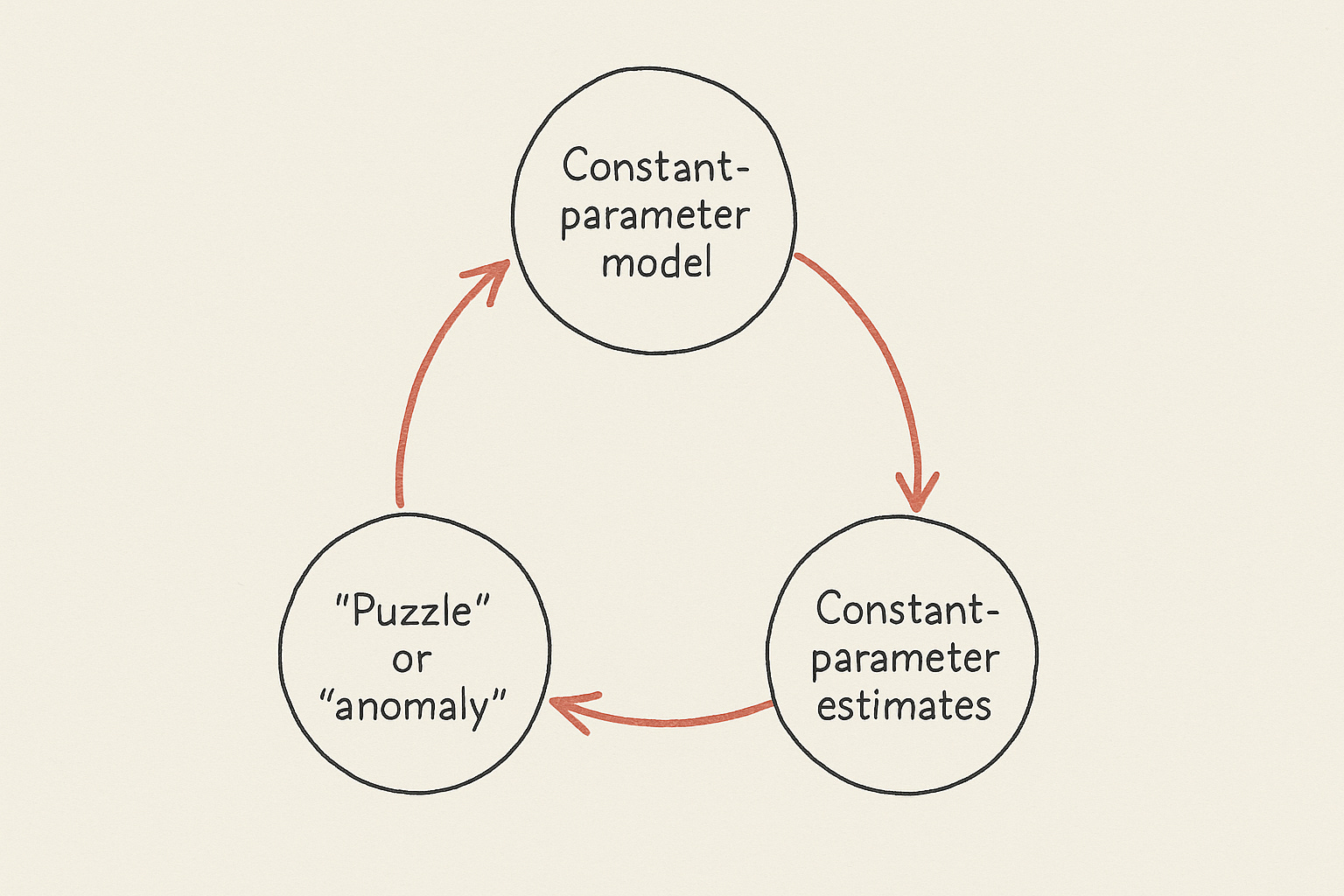
If we rule out structural change by assumption, then any persistent deviation between the model and the data has to be interpreted as something else:
An anomaly in expectations (informational rigidities, learning delays, irrationality).
A new friction (search costs, adjustment costs, sticky something).
A new shock we hadn’t thought of (preference shock, discount factor shock, risk-premium shock).
I am not claiming that these mechanisms never exist. Many are real and important.
But if the economy’s true structure is changing—if the mapping from today’s observables to future outcomes keeps evolving in ways we cannot foresee—then part of what we call “expectations puzzles” or “behavioral anomalies” may simply be the result of that instability. It typically shows up as highly persistent deviations of the variables we seek to explain from the steady state estimated as if it were constant.
The assumption of “no structural change” acts as a filter: whatever we cannot explain within this modeling framework is pushed into the residual and then rebranded as a deep feature of behavior or preferences that our theories ought to explain. We end up developing rich literatures on phenomena that partly reflect model misspecification.
Let me make this concrete with three specific examples. In each example, we will see the same pattern: a fixed-structure model and constant-parameter empirics combine to produce “puzzles” that are then accounted for by adding special features of expectations, behavior, rigidities, or frictions rather than by questioning the assumption of no structural change.
Example 1: Predictable Forecast Errors
We start from a well-known theoretical result: In constant-parameter models, the rational expectations hypothesis (REH) with full information implies that individuals’ ex post forecast errors should be unpredictable. They should be unbiased (zero on average) and uncorrelated with information available when the expectations were formed.
Empirically, survey-based expectations of inflation, GDP growth, or corporate earnings are typically predictable using past information. There appear to be systematic patterns: the forecast errors of individuals, professional forecasters, and central bankers are significantly biased and/or correlated with past information, and the sizes of the bias and correlations are substantial.
Within a constant-structure framing, the natural conclusion is:
Rational individuals must face information rigidities.
They don’t fully update their expectations due to attention costs.
Or, their expectations are irrationally distorted by psychological factors.
Entire literatures are built right there.
But there is an alternative possibility: the economic environment individuals are trying to forecast is itself evolving. The relationships they rely on—between policy and inflation, between technology and output, between corporate earnings and stock prices—break and re-form over time.
In that world:
Rational individuals are revising and experimenting with forecasting rules, as there is no single optimal way to forecast a future that differs from the past.
Structural shifts show up as stretches where the old forecasting rule keeps being used even as outcomes change, or where the forecasting rules are revised in anticipation of future changes in outcomes that have not yet occurred.
When we, as econometricians, estimate a single, constant-parameter regression across multiple regimes, we will find systematic forecast errors even if individuals were rationally doing their best to forecast in a structurally changing environment.
Once we allow for the possibility of structural change and actually look for it, the empirical picture shifts; see Frydman and Tabor (2025b) and my explanation in “Do Professional Forecasters Make the Same Systematic Forecast Errors Over Time?” When we identify structural shifts in the predictive relationship, or estimate it separately for reasonable subsamples, we often find that the strong, stable predictability suggested by constant-parameter regressions was an illusion. The apparent “stylized fact” was an artifact of imposing a stable structure on structurally unstable data, driven by particular episodes where the predictability was present. In other periods—including much of what we call the Great Moderation—the predictive relation largely disappears, though not completely.
In that light, the requirement that theories of expectations must explain a single, time-invariant pattern of predictable survey forecast errors is partly an artifact of the “no structural change” lens. Thus, the assumption of constancy not only shapes our models; it also shapes what we take to be the facts. Once structural change is taken seriously, we no longer have one uniform “fact” to explain, but a more nuanced history of when and where expectations were predictable.
Example 2: Are Equity Returns Driven By Discount Factors or Shifting Expectations?
Asset pricing is another topic where constant-parameter models with rational expectations have led us in a particular direction.
The model setup is typically:
Constant preferences and technology.
Rational expectations.
A fixed structure linking consumption, dividends, prices, and returns.
This yields the fundamental asset pricing equation: asset prices equal the asset’s expected return discounted by a stochastic discount factor. So asset prices are driven by rational expectations and stochastic discount factors.
But in constant-parameter models, rational expectations are completely pinned down by the model’s structure. By construction, they are driven solely by random shocks and deviate from actual future outcomes only by a random error. Thus, rational market participants’ expectations of future returns, dividends, or earnings do not play a serious role in driving asset prices.
Therefore, to explain the observed variability in price-dividends or price-earnings ratios, you typically end up with:
Very volatile stochastic discount factors (time-varying risk premia, discount-rate shocks).
The same logic is usually applied to findings of asset return predictability. When valuation ratios, dividend yields, or other state variables predict future returns, constant-parameter models with rational expectations naturally interpret this as evidence of strongly time-varying expected returns—shifting risk premia—rather than as evidence that beliefs about future cash flows are moving around in a changing investment environment.
But once we take structural change seriously in the empirical work, even this “stylized fact” of stable, time-invariant predictability starts to dissolve. Timmermann (2008) shows that stock return predictability appears in “pockets of predictability”: short episodes with significant predictability interspersed with long periods where returns are essentially unpredictable, rather than a single, stable predictive relationship running through the whole sample; see Rossi (2021) for a recent survey. In other words, what looks like a constant predictive relationship in a full-sample, constant-parameter regression turns out to be episodic and varying when we look for structural change.
Survey data on expectations paints a complementary, and in some ways starker, picture. Market participants’ survey-based expectations of future dividends and earnings show that:
A large share—sometimes the majority—of the variation in valuation ratios is associated with changes in subjective expectations of future cash flows, not with changes in expected returns.
These expectations respond to news, narratives, perceived technological shifts, and changes in the competitive or regulatory environment.
See Adam and Nagel (2023) for a recent survey of these and other empirical findings in asset pricing based on survey expectations.
In a world of unforeseeable change, these findings are what you would expect. The economy that generates future dividends and earnings is not a stable, stationary machine. Entire sectors rise and fall; new technologies emerge; regulation and global supply chains reconfigure. It is natural that investors’ beliefs about future cash flows move around a lot. It is natural that those beliefs are dispersed as we disagree about how to map our information and knowledge into expectations of a future that differs from what we have experienced in the past. It is natural that we discuss whether the current stock prices of AI and related companies are too high or too low because we cannot know whether they will create future profits that validate today’s prices.
If we insist on forcing a constant-structure model onto this reality, we push the shifts in expectations into the risk-premium box: “it must be discount factors.” We risk exaggerating the role of volatile risk premia and understating the role of evolving narratives and expectations about a changing world.
I admit that structural change does not solve all asset pricing puzzles, and I do not claim that time-varying stochastic discount factors are unimportant. But taking structural change seriously in economic models and empirical work changes the balance of the facts we seek to account for and the explanations we are willing to explore.
Example 3: The Phillips Curve and the “Missing Inflation/Disinflation” Puzzles
The Phillips curve is perhaps the most famous example of a relationship treated as if it were constant, but where empirical evidence suggests otherwise.
Many constant-parameter macro models assume:
A stable relationship between slack (unemployment, output gaps) and inflation.
Inflation dynamics are governed by a fixed equation, often with rational expectations, cost-push shocks, and a few parameters that are assumed constant.
We then estimate the relationship between inflation and slack on long samples under the assumption that the parameters are constant. Such estimated Phillips curve relations, however, have had difficulties in accounting for key inflation episodes, so we talk about:
The “missing disinflation” after the Great Recession: unemployment rose, but inflation didn’t fall as much as predicted by the Phillips curve.
The “missing inflation” in the 2010s: unemployment fell, but inflation remained subdued and often below target.
This all boils down to actual inflation deviating persistently, and for long stretches of time, from the steady state estimated as if it were constant.
As in the other examples, a constant-structure mindset causes us to reach for explanations within a fixed model:
Expectations have become more firmly anchored, or they only adjust to news gradually.
New nominal rigidities or nonlinearities must be added.
The output gap is mismeasured.
These mechanisms may all play some part. From the perspective of this post, the key point is not that the Phillips curve is dead or that anchored expectations and nominal rigidities do not matter. It is that the underlying “no structural change” assumption determines the development of theory, how the theory is confronted with empirical evidence, and what the theoretical response is to discrepancies between theory and data.
What is largely missing is the idea that the Phillips curve itself is not a stable relationship but a historically contingent relationship that has changed fundamentally over time.
Indeed, when researchers explicitly test for structural breaks or allow for time-varying parameters, they often find that:
There have been multiple structural breaks in the Phillips curve.
Its slope and persistence are regime-dependent: they differ across periods characterized by high inflation, disinflation, credible inflation targeting, etc.
The relation between inflation and slack is sensitive to changes in labor market institutions, openness to trade, and monetary regimes.
These findings intuitively make sense given the last 50 years of economic history characterized by major shifts in monetary policy, changes in labor market institutions and declining bargaining power, increased globalization, and the entrance of low-cost producers into world markets.
The empirical findings of structural change in the Phillips curve should be taken seriously. Instead of trying to add new imperfections and rigidities to constant-parameter models, we should at least explore the possibility of building economic models based on the idea that the behavior, expectations, technology, and policy rules that underpin the Phillips curve change over time in ways we cannot foresee. If we do that, some of the “puzzles” might look less puzzling.
What Changes When We Accord Structural Change a Central Role in Economics?
Giving unforeseeable structural change a central role in economic modeling is not just a technical adjustment. It changes the way we think about uncertainty, expectations, and the relationship between model and reality.
Here are a few consequences:
1. Knightian Uncertainty Instead of Probabilistic Risk
Once we acknowledge that the economy undergoes unforeseeable structural change, it follows that we—both economists and market participants—face Knightian uncertainty about the future. What is uncertain is not just which outcome will be realized, but also which model of the world will characterize the future: which relationships will hold, how and when parameters will change, and which states are even possible.
This is different from probabilistic risk. Risk can be represented by a single probability distribution, conditional on a given structure.
Knightian uncertainty arises precisely because the economy’s structure changes in ways and at times we cannot foresee, even in probabilistic terms. It is therefore inherently impossible to resolve this uncertainty and reduce it to a single probability distribution.
Recognizing this does not mean we must abandon theoretical or empirical modeling. It does, however, mean that models should be explicitly formalized such that their future structure cannot be known in advance. On the theoretical side, this means opening economic models to nonrepetitive—and thus unforeseeable—structural change (as I discuss in “Opening Economic Models to Knightian Uncertainty” and “Rational Expectations Under Knightian Uncertainty — Part 2”). On the empirical side, it suggests starting from the premise that the economy is structurally unstable—and then asking where, and how, that instability shows up—rather than taking constancy as the default and treating instability as the exception.
2. Rational Expectations are Diverse, Influenced by Psychology, and Sometimes Predictable
Once we move from probabilistic risk to Knightian uncertainty, the usual representation and understanding of rational expectations changes.
The rational expectations hypothesis (REH) represents rational expectations under probabilistic risk in constant-parameter models (or models with repetitive regime switching). REH does so by representing market participants’ expectations with the model’s conditional expectation of future outcomes. Thus, rational expectations are completely pinned down by the model’s structure and reduce to perfect probabilistic foresight, which implies that:
There is one rational way to map information into expectations.
If rational individuals share the same information, their expectations should be identical.
With full information, expectations should deviate from actual outcomes only by a random, unpredictable error.
Psychological factors are irreconcilable with rationality: as they distort expectations relative to the model’s conditional expectation, they are, by definition, interpreted as a source of irrationality.
Once we acknowledge Knightian uncertainty arising from unforeseeable change, this representation breaks down. In the models Roman Frydman and I have developed—see Frydman and Tabor (2025a) and my series “Rational Expectations Under Knightian Uncertainty”—the parameters that govern how the economy behaves shift in nonrepetitive, and thus unforeseeable, ways within bounds. Ex post, given a realized history, we can estimate those parameters. But ex ante, at the time individuals form expectations, the future parameters—and therefore the model’s conditional expectation of future outcomes—are inherently unknowable. This provides a tractable and empirically testable way to formalize the idea that neither economists nor market participants can have perfect probabilistic foresight; they face Knightian uncertainty.
Our formalization of rational expectations under Knightian uncertainty represents these expectations as model-consistent, but changes what that means under Knightian uncertainty compared to in REH models with constant parameters:
The model specifies an interval within which future parameters can lie.
Rational individuals’ expectations are represented in terms of subjective parameters that lie within the same interval, but whose values and shifts over time are left open.
Expectations are thus consistent with the model’s structure and bounds, but not pinned down by a single, objectively correct conditional expectation.
This seemingly small change has big consequences for how we understand rational expectations.
First, rational expectations become diverse. When the model’s own conditional expectation is unknowable ex ante, there is no single, “objective” way to map today’s information into beliefs about the future. Individuals thus have diverse expectations. This is represented in terms of diverse subjective assessments of how the future parameters might change—different ways of thinking about how the structure might change—while still staying wihtin the model’s bounds. Even with identical information, there are many rational expectations, not just one.
Second, psychological factors and narratives play a role in rational expectation formation and decision-making. When the future structure is open-ended, Keynes’ point becomes unavoidable: conventions, narratives, confidence, and other psychological factors are part of rationality. They are not classified as irrational, but rather part of how rational individuals cope with an environment that changes in ways that cannot be quantified solely based on fundamentals.
Third, rational individuals’ forecast errors are no longer just random and unpredictable. Because the structure changes in unforeseeable ways, even fully informed, rational individuals will sometimes be roughly right (when the structure remains stable) and sometimes very wrong (when it shifts unexpectedly). Ex post forecast errors will therefore be biased and predictable in some periods, but not in others. That is exactly what we see in survey data when we look for structural change.
In short, both REH and KMH represent rational expectations as model-consistent. But because they do so in models with different assumptions about structural change, they apply that idea to very different worlds.
Under REH with probabilistic risk, rational expectations are:
Identical given the same information.
Driven only by fundamentals.
Deviating from outcomes only by random, unpredictable errors.
Under KMH with Knightian uncertainty, rational expectations are:
Diverse, even with the same information.
Driven by fundamentals and shaped by psychological and narrative factors.
Deviating from outcomes in ways that can be large, and whose bias and predictability shift over time.
I explain the details of this representation and its implications in Part 3 and Part 4 of my series “Rational Expectations Under Knightian Uncertainty”. Here, the point is conceptual: once we build Knightian uncertainty arising from unforeseeable change into our models, rational expectations cease to be a synonym for perfect probabilistic foresight.
3. What Economists Can (and Cannot) Know About the Future
Once we acknowledge structural change and Knightian uncertainty, we have to give up on a comforting idea: that, in principle, we could know exactly (in probabilistic terms) what will happen in the future if only we had the right model and enough data.
We simply cannot.
We cannot know exactly how earnings will evolve for firms whose business models depend on new, evolving technologies such as AI. We cannot know which products will scale, which regulations will emerge, which competitors will appear, or how these developments will map into future profits and thus asset prices. Likewise, we cannot know exactly how a change in the policy interest rate will feed into expectations, financial conditions, and inflation. The transmission mechanism itself can shift with institutions, narratives, and balance sheets.
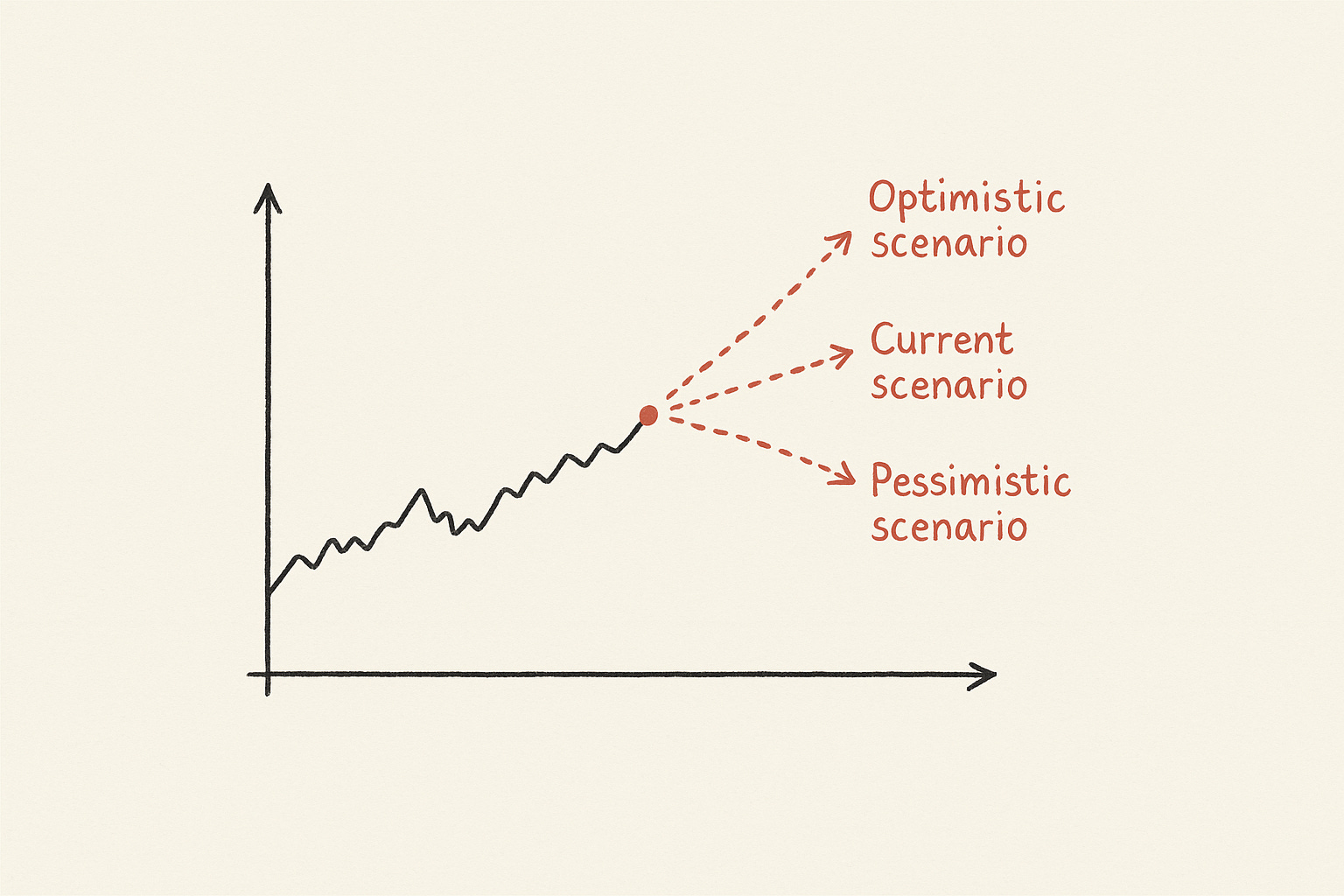
What we can do is something more modest but still valuable: make predictions contingent on structural scenarios.
Instead of saying, “Given today’s data and our model, the future follows this one probability distribution,” we say things like:
If the structure remains broadly stable over the near future—if the relationships between expected earnings, discount rates, and risk appetite persist—then we expect valuation ratios to move in this way.
If the structure changes along a particular scenario—say, a new regulatory regime for AI, or a sharp rise in geopolitical uncertainty—then we expect this pattern of earnings and asset prices.
If the monetary policy transmission channel remains similar to the recent past, then a given rate hike is likely to have this effect on inflation.
If financial conditions, expectations, or institutional arrangements shift according to these scenarios, then the same rate hike would have these impacts.
In other words, we move from single-point predictions to sets of possible paths, each tied to a different structural scenario. We might not be able to provide a precise numerical forecast—“inflation will be 2.1% next year with distribution X”—that we trust in a structurally unstable world. But we can specify:
A range of plausible scenarios for how the structure might evolve.
A corresponding range of model-based implications under each scenario.
This is not an abdication of rigor. It is a change in what rigor looks like under Knightian uncertainty. Instead of pretending to know more than we do by wrapping everything into one estimated distribution, we are explicit that our knowledge is contingent and partial: if the world stays roughly like this, then…; if it changes in that way, then…
Acknowledging these limits is not a weakness of economics; it is the condition for using models honestly in a world whose structure we know will keep changing in ways we cannot fully foresee.
Closing: The Cost of Assuming the World is Constant
None of this is an argument against formal economics. Instead, it is an argument for building theoretical models and econometric methods that start with the assumption that the economy evolves and undergoes structural change, not that it remains constant.
We acknowledge that economies change: preferences, technologies, and institutions evolve and new ones emerge, often in ways that we could not have foreseen. That is the root cause of Knightian uncertainty.
Yet, most of economics is based on the assumption that the economy’s structure can be modeled as constant, as if the future is merely a probabilistic replica of the past. This assumption is not merely a harmless simplification. It determines the development of theory, how it is confronted with empirical evidence, what empirical “facts” we seek to account for, and what theoretical explanations we explore to account for discrepancies between theory and data.
The danger is not just that we get some forecasts wrong. It is that we build entire research programs around explaining “puzzles” that arise, in part, from forcing a constant-structure lens onto a structurally changing reality.
Placing structural change at the center of theoretical and empirical work, some of these puzzles might shrink or change shape; our interpretations of expectations and behavior would be less moralizing (“people are irrational”) and more historically grounded; and our models would become more modest by acknowledging that we, both economists and market participants, cannot perfectly foresee what will happen in the future.
“All models are abstractions” is correct. But it is not the end of the discussion. The real question is: which parts of reality can we safely abstract from and ignore, and which parts are too central to leave out?
Unforeseeable structural change belongs in the second category.
References
Adam, Klaus, and Nagel, Stefan (2023), “Expectations Data in Asset Pricing,” in Bachmann, Topa, and Van Der Klaauw (Editors), “Handbook of Economic Expectations,” Academic Press. Link.
Frydman, Roman, and Tabor, Morten Nyboe (2025a), “Rational Expectations of Inflation Undergoing Unforeseeable Change,” INET Center on Knightian Uncertainty Working Paper #1. Link.
Frydman, Roman, and Tabor, Morten Nyboe (2025b), “Unforeseeable Change in Rational Participants’ Inflation Expectations: Evidence From Forecast-Error Regressions,” INET Center on Knightian Uncertainty Working Paper #2. Link.
Rossi, Barbara (2021), “Forecasting in the Presence of Instabilities: How We Know Whether Models Predict Well and How to Improve Them,” Journal of Economic Literature, 59 (4). Link.
Timmermann, Allan (2008), “Elusive Return Predictability,” International Journal of Forecasting, 24 (1). Link.